


Wednesday, December 24, 2025
  • About
  • Contact
  • Privacy Policy
Ecobuild.club
  • Home
  • Sustainability
  • Insulation
  • Energy Efficiency
  • Eco Build
  • Green Energy
  • Natural Global Resources
  • Videos
No Result
View All Result
Ecobuild.club
Home Energy Efficiency

Trump’s Solar Tariffs Blamed for 15 Percent Decline in Large-Scale Solar Installations in Q3 2018

14th December 2018
in Energy Efficiency
0
Trump’s Solar Tariffs Blamed for 15 Percent Decline in Large-Scale Solar Installations in Q3 2018
0
SHARES
20
VIEWS
Share on FacebookShare on Twitter

Related posts

Denver vehicle-to-building pilot yields net benefits

Denver vehicle-to-building pilot yields net benefits

10th December 2021
India’s wind market is ready for its comeback

Building out renewables in India could cost $26.5b through 2030, report says

10th December 2021

On Thursday, Wood Mackenzie Power & Renewables and the Solar Energy Industries Association (SEIA) reported results of their analysis of U.S. solar installations in the third quarter of 2018. While large-scale solar installations fell, the residential market continued to stabilize after falling in 2017, said the analysts. Overall, they said they expect 2018 growth to be flat.

For the first time since 2015, quarterly additions of utility-scale solar photovoltaics (PV) fell below 1 gigawatt (GW), highlighting the impact of the tariffs and the uncertainty surrounding them in late 2017 and early 2018. As a result, the U.S. solar market was down 15 percent year-over-year in the third quarter of the year, but the report notes that a strong project pipeline lies ahead.

“Developers originally planning to bring projects online in Q3 2018 were forced to push out completion dates to Q4 2018 or Q1 2019 due to uncertainty around tariffs,” said Colin Smith, Senior Analyst at Wood Mackenzie.

“We did, however, see utility PV procurement outpace installations fourfold in Q3, showing that despite the tariffs causing project delays, there is substantial growth ahead for the U.S. utility PV sector.”

Even with the tariffs, the report forecasts 3.5 GW of utility PV for Q4 2018, and projects that the fourth quarter will be the largest quarter for utility PV installations since Q4 2016, as Wood Mackenzie expects many of the delayed projects to come online by the end of the year.

[Native Advertisement]

FIGURE: U.S. Utility PV Pipeline

/var/folders/w7/rgddyj0s51g8p_2t19f2klg5hz1xnq/T/com.microsoft.Word/WebArchiveCopyPasteTempFiles/Q3_FIGURE_U.S._Utility_PV_Pipeline.png

Credit: Wood Mackenzie Power & Renewables

On the residential side, Q3 was the third consecutive quarter in which residential PV was essentially flat or marginally up on both a year-over-year and quarter-over-quarter basis after the market had contracted by 15 percent in 2017. Nevada was a particular bright spot as the state experienced steady installation growth, and Florida is on pace for a strong year.

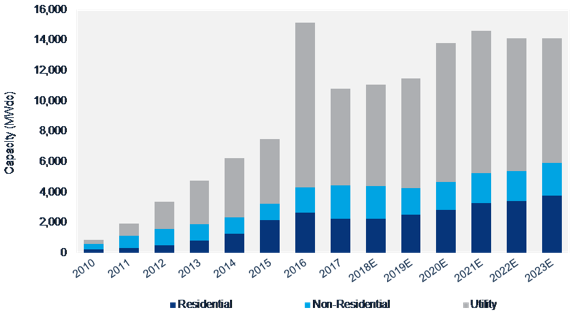
Slightly improving their 2018 forecast, Wood Mackenzie now expects a total of 11.1 GW of new PV installations to come online by the end of the year.

The report said there was positive quarterly growth in the non-residential solar segment despite a year-over-year decline. California’s commercial sector experienced solid growth and New York saw a record-breaking quarter. Minnesota’s community solar build out continued, with more than 400 megawatts added so far this year.

“If not for the tariffs, the U.S. solar market would undoubtedly look better today than it does now,” said Abigail Ross Hopper, SEIA’s president and CEO. “However, as this report shows, this is a resilient industry that cannot be kept down for long. With smart policies in place, the potential for the solar industry is hard to overstate.”

Total installed U.S. PV capacity is expected to more than double over the next five years. By 2023, more than 14 GWdc of PV capacity will be installed annually.

Source

Previous Post

Malawi is Putting its Money Where its Forests Are

Next Post

‘Fire-fighting approach’ to humanitarian aid ‘not sustainable’: Deputy UN chief

Next Post
‘Fire-fighting approach’ to humanitarian aid ‘not sustainable’: Deputy UN chief

‘Fire-fighting approach’ to humanitarian aid ‘not sustainable’: Deputy UN chief

Leave a Reply Cancel reply

Your email address will not be published. Required fields are marked *

RECOMMENDED NEWS

ZERB Accelerator Progress in Colombia, Kenya, Philippines

5 days ago

Progress at COP30 toward $1.3 Trillion, and What’s Next

5 days ago

Nigeria Puts Youth at the Heart of Its Climate Future

7 days ago

Our 15 Biggest Stories of 2025

7 days ago

POPULAR NEWS

  • COP28: Extraction of minerals needed for green energy must be ‘sustainable and just’, says Guterres

    0 shares
    Share 0 Tweet 0
  • Live blog of International Women’s Day | 7 March 2025

    0 shares
    Share 0 Tweet 0
  • 5 Things COP27 Must Achieve for Vulnerable Countries

    0 shares
    Share 0 Tweet 0
  • Mixed efforts to achieve energy goals highlighted at the end of Sustainability Week

    0 shares
    Share 0 Tweet 0
  • Top UN forum meets to ‘build political momentum’ for SDGs

    0 shares
    Share 0 Tweet 0
Ecobuild.club

ecobuild.club is an online news portal which aims to provide knowledge about Sustainability, Insulation, Energy Efficiency, Eco Build, Green Energy & Natural Global Resources.

Follow us on social media:

Recent News

  • ZERB Accelerator Progress in Colombia, Kenya, Philippines
  • Progress at COP30 toward $1.3 Trillion, and What’s Next
  • Nigeria Puts Youth at the Heart of Its Climate Future

Category

  • Eco Build
  • Energy Efficiency
  • Green Energy
  • Insulation
  • Natural Global Resources
  • Sustainability
  • Videos

Subscribe to get more!

  • About
  • Contact
  • Privacy Policy

© 2018 EcoBuild.club - All about Eco Friendly Environment !

No Result
View All Result
  • Home
  • Sustainability
  • Insulation
  • Energy Efficiency
  • Eco Build
  • Green Energy
  • Natural Global Resources
  • Videos

© 2018 EcoBuild.club - All about Eco Friendly Environment !