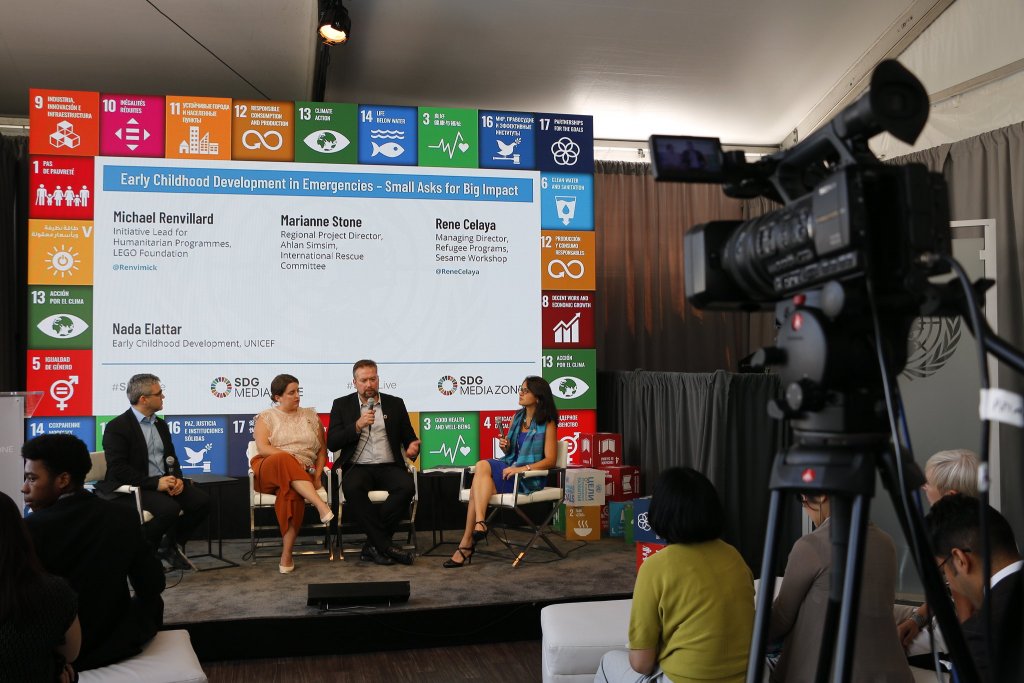
Laura Parker, Environment Desk Editor at the National Geographic Magazine, in conversation with Dia Mirza, Actress, SDG Advocate, and UN Environment Goodwill Ambassador for India, and Sonika Manandhar, Young Champion of the Earth for the UN Environment Programme, discussed the issue of plastics around the world, as well as climate solutions centered on green energy and products. Mirza emphasized the havoc plastics have caused to the soil and air but noted that there had been a significant shift in consciousness. Plastics wage war to health and the environment, she said. Manandhar highlighted how the promotion of electric mobility in public transportation sector was driven by women.

Sustainable, Climate-conscious and Delicious Food
The home of Louise Mabulo (Young Champion of the Earth, UN Environment) was affected by a typhoon in the Philippines, which eliminated food sources and power, and destroyed 80% of agricultural land. This created the need for short term and climate resilient crops, restoring livelihoods for farmers. There is also the need to appreciate the value of farmers’ hard work, so that food is not wasted. The crop cacao was found to be stable crop that could grow in strong and windy conditions. Mabulo hopes the Philippines is able to grow chocolate soon.
Restaurateur Massimo Bottura’s community kitchens aim to eliminate food waste and promote social inclusion. These spaces were created during the World Expo in Milan first, then Rio de Janeiro, with the Food for Soul Foundation. Bottura uses his image and influence to put together a community to help and restore the soul of people. He has 8 community kitchens around the world, with plans to add more. Bottura focused on the most neglected neighborhoods in the city to serve nourishing dishes to preserve the dignity of the communities living there. He has since collaborated with social organisations, world class chefs and supermarkets, as is planning to bring this to the US. Working with Google, he has found that most food waste is produced in our homes, so he encourages individuals to buy seasonal, mindful, and local foods which is going to help save money and the world.
Dr. Bertrand Piccard’s father, Jacques Piccard, who was an oceanographer, thought that it would be useful to show that there is life in the deepest part of the ocean. This has helped to prohibit the dumping of toxic waste in the ocean. Knowledge can help governments change the regulations, he said. Dr. Piccard, an Aeronaut and UN Environment Goodwill Ambassador, thinks that new technologies show that the old world of pollution will no longer happen. We have to reign in the greed that makes companies produce food and other products with chemicals in them. He says that his dream was to fly with solar power airplanes and show the world it can be done.
Dr. Enric Sala, world-famous marine ecologist and Marine Ecologist, National Geographic Explorer-in-Residence, works with communities and governments to protect oceans. Challenges related to this are interconnected; in order to live you need to drink and breathe. Sala also started that if the ocean couldn’t absorb heat, it would be 36 degrees warmer here. “What we believe is natural, is not natural, but if we let nature recover, the results would be spectacular,” he said.
Underwater, we are seeing coral reefs dying. The ocean has absorbed 90% of heat, and it’s killing marine life like we have never seen. Our activities on the planet are causing this chaos.

According to Dr. Zweli Mkhize there will be a universal health care introduced to South Africa and the important thing is to make sure the resources are met because some people are in a more powerful position and some are neglected. It is important to have a framework to protect the vulnerable. Mkhize states that it is foremost the government’s duty to protect universal healthcare and that the people should protest in case fundamental rights to clean water and food are not provided.

However, there is a need to move to a stage where development and conservation go hand in hand. The best way to interact with communities is to start with children. Telling children stories, build on them and expand. Teach them about how conservation will benefit their lives. Empowering people at all levels and making them feel it is a story about them, embraces their views and needs and can eventually lead to success. If you change a culture, you wont need to increase security.

According to Dr. Agnès Soucat, health coverage is within our reach and there has been major increase getting access to it within the past 15 years, but we are not well enough prepared for climate change. Climate change and general environment degradation threaten the progress together with processed and industrial food. Dr. Soucat also warns us that an ‘’epidemic influenza may be coming because of climate change.’’

Climate Hour at the United Nations: Interviews with Global Leaders on Their Commitment to Climate Action

Taking the floor after him was, Jesper Brodin, CEO of IKEA Group, who emphasized the need to find ways to change the equation of the business. Citing an example, he said that the company plans to invest more in renewables. The SDG Media Zone wrapped up its 23 September with an interview Lisa Kingo, the CEO of the UN Global Compact, who commended the commitments of CEOs to prove that a 1.5°C-compliant business model is possible.