
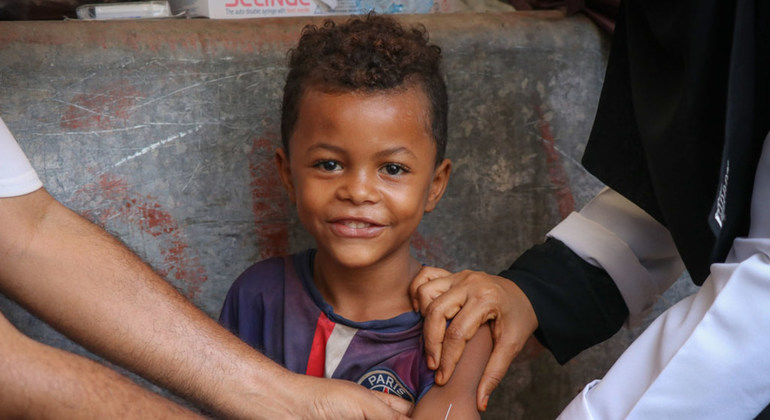
According to a joint study by the World Health Organization (WHO) and UN Children’s Fund (UNICEF), 10 countries accounted for 11.7 of the 19.4 million under and non-vaccinated youngsters in the world, in particular Nigeria (three million), India (2.6 million) and Pakistan (1.4 million).
At the same time, global protection against four diseases that are regarded as a gauge of overall coverage – diphtheria, tetanus, pertussis and measles – has “stalled” at around 86 per cent since 2010, the study found.
95 per cent coverage rate still eludes many countries
A far higher level of coverage is needed to protect against vaccine-preventable disease outbreaks, UN health experts insist, noting that 118 countries achieved a 90 per cent coverage threshold last year. Ideally, it should be 95 per cent across countries and communities globally, they maintain.
“Vaccines are one of our most important tools for preventing outbreaks and keeping the world safe,” said Dr. Tedros Adhanom Ghebreyesus, WHO Director-General.
He added that while most of the world’s children are being vaccinated, “far too many are left behind…It’s often those who are most at risk – the poorest, the most marginalized, those touched by conflict or forced from their homes – who are persistently missed.”
Data shows that the best regional performer for vaccine reach in 2018 was Europe, whose more than 90 per cent rate was 18 per cent higher than Africa, the lowest-performing region.
Worryingly, of the 19.4 million children worldwide who have not received three doses of vaccine to protect against diphtheria, tetanus, pertussis – two-thirds “didn’t even receive an initial dose”, the UN report noted, underscoring that this points to a lack of basic immunization services.
Most unvaccinated children come from the world’s poorest countries and a disproportionate number live in fragile or conflict-affected states.
Conflict-hit countries are home to most at-risk children
Almost half of these at-risk youngsters are in 16 countries: Afghanistan, the Central African Republic, Chad, Democratic Republic of the Congo (DRC), Ethiopia, Haiti, Iraq, Mali, Niger, Nigeria, Pakistan, Somalia, South Sudan, Sudan, Syria and Yemen.
“If these children do get sick, they are at risk of the severest health consequences, and least likely to access lifesaving treatment and care,” WHO/UNICEF said in a joint statement.
Measles outbreaks reveal ‘entrenched gaps’ in coverage
Citing major gaps in measles vaccine coverage across countries at all income levels, from Ukraine to the DRC to Madgascar, the UN report showed that the number of cases of the highly infectious disease doubled from 2017 to 2018, to more than 340,000.
“Measles is a real time indicator of where we have more work to do to fight preventable diseases,” said UNICEF’s Executive Director, Henrietta Fore. “Because measles is so contagious, an outbreak points to communities that are missing out on vaccines due to access, costs or, in some places, complacency. We have to exhaust every effort to immunize every child.”
Identifying Ukraine as the country with the highest measles incidence rate in 2018, the WHO/UNICEF report suggested that although the country has vaccinated over 90 per cent of its children, coverage in 2010 was just 56 per cent, meaning that a large number of older children and adults were at risk.
For first time, data available on vaccine that protects girls from cervical cancer
Data is also available for the first time on coverage of the human papillomavirus (HPV) vaccine, which protects girls against cervical cancer later in life.
As of 2018, 90 countries – home to one in three girls worldwide – offered the HPV vaccine.
But only 13 of these were lower-income countries, WHO/UNICEF said, meaning that those most at risk of cervical cancer are still least likely to have access to the vaccine.

