
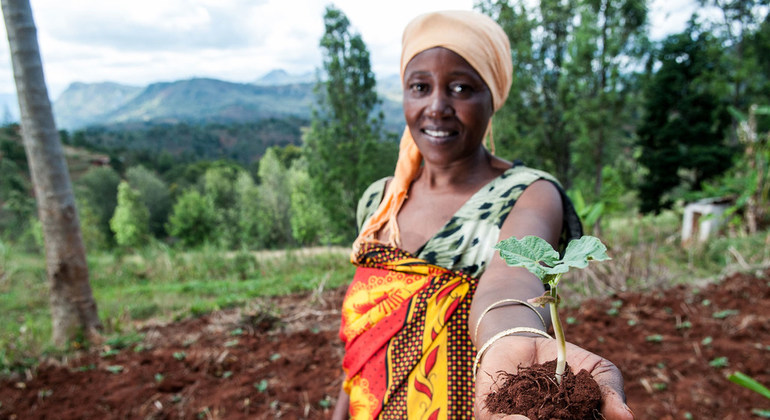
Soil salinization refers to excessive levels of salt in the soil, which can inhibit plant growth and even be toxic to life. It can occur naturally, for example in deserts due to lack of water and intense evaporation, or as a consequence of human activity.
FAO is highlighting the issue in marking World Soil Day on Friday, ahead of the official commemoration on Sunday.
Soils at risk
“Soil is the foundation of agriculture and the world’s farmers depend on soil to produce about 95 per cent of the food we eat. Yet, our soils are at risk,” said Qu Dongyu, the agency’s Director-General, in advance of the Day, which is organized around the theme of Halt soil salinization, boost soil productivity.
FAO said unsustainable agricultural practices and the overexploitation of natural resources, as well as a growing global population, are putting increased pressure on soils and causing alarming rates of soil degradation worldwide.
More than 833 million hectares of soils are already salt-affected, representing around nine per cent of the world’s land surface, or roughly four times the size of India.
Salt-affected soils occur in all continents, and under almost all climatic conditions, but more than two-thirds are in arid and semi-arid zones.
Some of the regions most affected are in Central Asia, the Middle East, South America, North Africa and the Pacific.
Challenges in Uzbekistan
Uzbekistan, located in Central Asia, is the world’s largest landlocked country, and is in turn surrounded by other landlocked nations. More than half the soils there are salt-affected, making it extremely difficult to farm productively.
Adyl Khujanov runs a farm in the village of Kyzylkesek, situated in the Karakalpakstan region in western Uzbekistan, which is considered the hottest and driest place in the country.
“I’ve been farming this land all of my life and seen so many people from this area leave over the years because of the heat, dry weather and water shortages,” he told FAO recently.
However, in other regions of the world, soil salination is attributed to unsustainable human activities. These include over use of fertilizers, inappropriate irrigation methods, poor quality water, and deforestation.
Learning new methods
FAO works with countries to support them in managing soil resources.
In Uzbekistan, FAO’s Global Soil Partnership (GSP) collaborates with scientists to develop climate-smart soil management practices so that crops in salt-affected areas can thrive.
“Thanks to new methods which we have learnt and adopted here to cope with climate change and severe water shortages, I can grow tomatoes, melons, pulses and forage crops to feed animals,” said Mr. Khujanov.
Reliable data critical
FAO has also stressed the importance of generating reliable soil data, though it warns that many countries face challenges in this area.
The agency has published the Global Soil Laboratory Assessment Report, which reveals that out of 142 countries surveyed, 55 per cent lack adequate capability for soil analysis. Most are in Africa and Asia.
At the report’s launch, Mr. Qu underlined the need for investment in soil laboratories to provide reliable data that will inform sound decisions for ensuring sustainable soil management and preventing degradation.
He said the recent adoption of a new Soil Strategy by the European Union (EU) is a positive example, setting concrete and ambitious targets to improve soil health within and outside the bloc.
FAO recalled that the vital role of healthy soils in climate change mitigation and adaptation and in building resilience figured prominently at the COP26 conference last month.
The agency has called on all countries to urgently improve their soil information and capacities by making stronger commitments towards sustainable soil management.


