
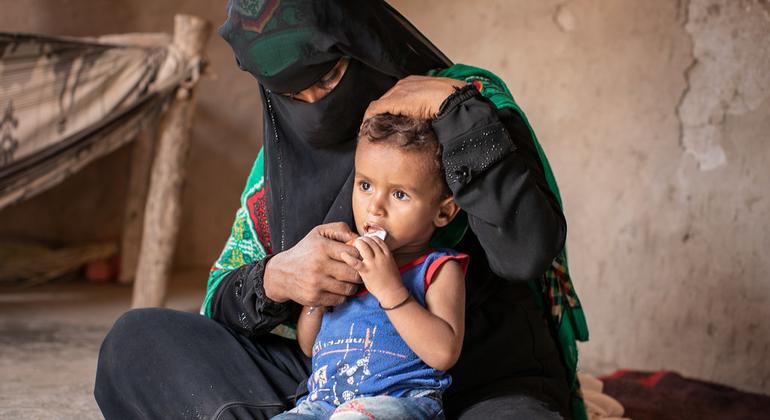
While rich nations were able to support their pandemic recovery with record sums borrowed at ultra-low interest rates, the poorest countries spent billions servicing debt, thus preventing them from investing in sustainable development.
COVID-19 pushed 77 million more people into extreme poverty in 2021, while many economies remained below pre-2019 levels, according to the Financing for Sustainable Development Report: Bridging the Finance Divide.
‘No excuse for inaction’
Furthermore, it is estimated that one in five developing countries will not see their Gross Domestic Product (GDP) return to 2019 levels by the end of next year, even before absorbing the impacts of the Ukraine conflict, which is already affecting food, energy, and finance across the globe.
The report was produced by the UN Department of Economic and Social Affairs (DESA) together with more than 60 international agencies, including within the UN system, and international financial institutions.
UN Deputy Secretary-General Amina Mohammed described the findings as “alarming”, given that the world is at the halfway mark for financing the Sustainable Development Goals (SDGs).
“There is no excuse for inaction at this defining moment of collective responsibility, to ensure hundreds of millions of people are lifted out of hunger and poverty. We must invest in access for decent and green jobs, social protection, healthcare and education leaving no one behind,” she said.
New challenges on the horizon
The report reveals that on average, the poorest developing countries pay around 14 per cent of revenue for interest on their debt, while the figure is 3.5 per cent for richer nations.
The pandemic forced governments to cut budgets for education, infrastructure and other capital spending. Fallouts from the war in Ukraine – such as higher energy and commodity prices, as well as renewed supply chain disruptions – will only exacerbate these challenges and spark new ones.
The war is also likely to result in further increases to debt distress and increased hunger, further widening “pandemic recovery gaps” that existed before the conflict.
Build on progress
Liu Zhenmin, the DESA chief, pointed to a potential silver lining for the way forward.
“The developed world proved in the last two years that millions can be lifted out of poverty by the right kind of investment – in resilient and clean infrastructure, social protection or public services,” he said.
“The international community must build on that progress, and ensure developing countries can invest at similar levels, while reducing inequality and securing a sustainable energy transition.”
The past year was also marked by some advances on poverty reduction, social protection and investment in sustainable development, driven by actions in develop countries and some large developing nations, including some $17 trillion in COVID-19 emergency spending.
Additionally, Official Development Assistance (ODA) reached $161.2 billion in 2020, the highest level ever.
However, 13 governments also cut this support to developing countries, and the record sum is still insufficient to meet the vast needs.
The UN fears that increased spending on refugees in Europe, another fallout of the war in Ukraine, could lead to cuts in aid to the world’s poorest countries.
Bridging the finance divide
To bridge the “great finance divide”, the report calls for countries to urgently address financing gaps and rising debt risks.
This can occur through several measures, such as speeding up debt relief and expanding eligibility to highly indebted middle-income countries.
“It would be a tragedy if donors increased their military expenditure at the expense of Official Development Assistance and climate action. And it would be a tragedy if developing countries continue to default, at the expense of investments in social services and climate resilience,” said Ms. Mohammed.
Financing flows must also be aligned with sustainable development and climate action. with the international tax system allowing for fair tax governance, trade and investment policy actions that counter vaccine inequality and improve access to medical products.
Enhanced transparency will strengthen countries’ ability to manage risks and use resources well. Measures here could include tackling illicit financial flows through improved sharing and use of tax information, as well as boosting transparency of debt data.