“The global coronavirus pandemic, which has already caused unimaginable devastation and hardship, has brought our way of life to an almost complete halt. The outbreak will have profound and lasting economic and social consequences in every corner of the globe. In the face of such turmoil, as the Secretary-General has indicated, COVID-19 will require a response like none before – a “war-time” plan in times of human crisis.
And as we inch from a “war-time” response to “building back better”, we need to take on board the environmental signals and what they mean for our future and wellbeing, because COVID-19 is by no means a “silver lining” for the environment.
Visible, positive impacts – whether through improved air quality or reduced greenhouse gas emissions – are but temporary, because they come on the back of tragic economic slowdown and human distress.
Visible, positive impacts come on the back of tragic economic slowdown and human distress Inger Andersen, Executive Director, UNEP
The pandemic will also result in an increase in the amounts of medical and hazardous waste generated. This is no one’s model of environmental response, least of all an environmentalist’s. And indeed, the Scripps Institute of Oceanography has highlighted that fossil fuel use would have to decline by about 10 percent around the world, and would need to be sustained for a year to show up clearly in carbon dioxide levels.
A healthy planet means fewer diseases
Any positive environmental impact in the wake of this abhorrent pandemic, must therefore be in our changing our production and consumption habits towards cleaner and greener. Because only long-term systemic shifts will change the trajectory of CO2 levels in the atmosphere. So, in the aftermath of the crisis, when economic stimulus packages composed of infrastructure are designed, there is a real opportunity to meet that demand with green packages of renewable energy investments, smart buildings, green and public transport, etc.
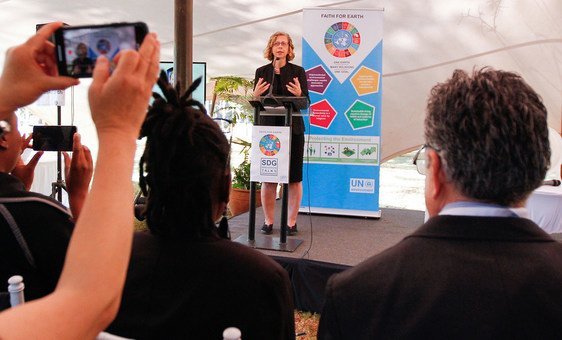
The Executive Director of the UN Environment Programme, Inger Andersen, addresses a meeting in Nairobi, Kenya., by UNEP/Cyril Villemain
With respect to the disease itself, part of the challenge ahead is understanding where such diseases come from, because the health of our planet plays an important role in the spread of zoonotic diseases, i.e. disease originating from pathogens that transfer from animals to humans. As we continue to encroach on fragile ecological ecosystems, we bring humans into ever-greater contact with wildlife. Further, illegal wildlife trade and illegal wet markets are not infrequent causes of such diseases. Around 75 per cent of new and infectious diseases are zoonotic and, in fact, about 1 billion cases of illness and millions of deaths occur every year from these diseases.
The wild must be kept wild
Humanity’s expansion on the terrestrial earth surface means that, today, human activity has altered almost 75 per cent of the earth’s surface, squeezing wildlife and nature into an ever-smaller corner of the planet. And yet, nature is critical to our own survival: nature provides us with our oxygen, regulates our weather patterns, pollinates our crops, produces our food, feed and fiber, but it is under increasing stress.
As we continue our relentless move into natural habitats, contact between humans and reservoir hosts increases, whether as a result of urbanization, habitat loss and fragmentation, or live animal markets – all of which increases the likelihood of interaction between these vectors and humans. According to IPBES, we have seen 100 million hectares of agricultural expansion in the tropics between 1980 and 2000, roughly equal to the size of France and Germany combined.
The “wild” must be kept “wild.” It is time to restore our forests, stop deforestation, invest in the management of protected areas, and propel markets for deforestation-free products. Where the legal wildlife trade chain exists, we need to do far better job of improving hygiene conditions. And of course, there is the urgent need to tackle the illegal wildlife trade, the fourth most common crime committed worldwide.
Building a ‘different economy’
The better we manage nature, the better we manage human health. This is why the post-2020 biodiversity framework that countries around the world are expected to agree on this year matters greatly. An important pillar in our post-COVID recovery plan must be to arrive at an ambitious, measurable and inclusive framework, because keeping nature rich, diverse and flourishing is part and parcel of our life’s support system. Even more important when you consider that between 25-50 per cent of pharmaceutical products are derived from genetic resources.
And as the engines of growth begin to rev up again, we need to see how prudent management of nature can be part of this “different economy” that must emerge, one where finance and actions fuel green jobs, green growth and a different way of life, because the health of people and the health of planet are one and the same, and both can thrive in equal measure.”