
That day was in November 2023, around a month into the war in Gaza. Ala’a is among an estimated 155,000 pregnant women and new mothers in the Gaza Strip who for the past year have been forced to give birth under fire, in tents, while fleeing bombs and often without assistance, medication or even clean water.
“The sound of the rockets and bombs was louder than my happiness, but I decided that with my little baby, we would overcome all difficulties,” she wrote in a letter thanking the tireless health staff who helped her deliver her baby in a field hospital in Khan Younis.
“We will survive whatever happens.”
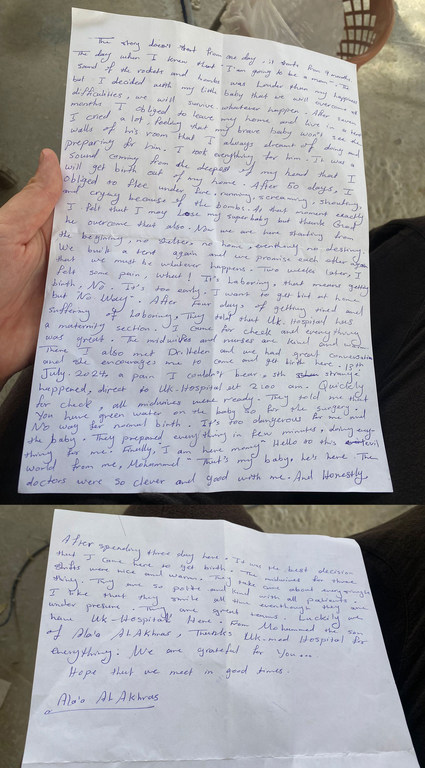
A letter from a mother in Gaza.
Catastrophic situation
The situation for pregnant women in Gaza is catastrophic: Exhausted, weak from hunger, with health services nearly completely destroyed and none of the hospitals fully operational, they have few places to turn for care and treatment.
After hundreds of attacks on medical facilities, just 17 out of 36 hospitals are even partially functioning.
Fuel and supplies are also running dangerously short, health-care workers are being killed or forced to flee and those that remain are stretched thin at a time when Gaza’s whole population is facing a surge in injuries, illnesses and diseases, including the first case of polio in over 25 years.
Perils of displacement
More than 500,000 women in Gaza have lost access to vital services like pre- and postnatal care, family planning and treatment for infections. Among them, over 17,000 pregnant women are on the brink of famine.
“After seven months, I was forced to leave my home and live in a tent,” Ala’a continued in her letter. “I cried a lot, feeling that my brave baby would never see the walls of his room that I had always dreamed of preparing for him.”
But, her anguish didn’t end there, as she was soon evacuated yet again.
“It was a cry from the depths of my heart [that I had] to give birth out of my home,” wrote Ala’a. “After 50 days I fled under fire, running, screaming and crying because of the bombs. At that moment, I feared I might lose my baby.”
Some 1.9 million people are currently displaced in Gaza, many of whom have already been forced to move multiple times over the past year. Since the start of the war, miscarriages, obstetric complications, low birth weight and premature births are reported to have risen at alarming rates, mainly due to stress, malnutrition and a near-total lack of maternity care.
Recalling her time escaping the bombardments, Ala’a wrote, “We are here, starting from nothing – no shelter, no home, not even a destiny. We built a tent again, and we promised each other again that we must survive, whatever happens.”
A glimmer of light
“Two weeks later I felt some pain…It was labour pains! [I thought] ‘No. It’s too early, I want to give birth at home.’”
After four days of labour, Ala’a visited a field hospital in Khan Younis run by UK-Med, a humanitarian non-governmental organization (NGO) that has a specialised maternity unit supported by the United Kingdom and the UN agency for sexual and reproductive health, UNFPA.
“I came for a check-up and everything was great,” she continued. “The midwife and nurses were kind and warm. I spoke to Dr. Helen, and she encouraged me to come and give birth there.”
When the time came, they made sure Ala’a delivered her baby safely.
“I went directly to the hospital at 2am and all the midwives were ready. But, they told me there was no way for a natural birth, it was too dangerous.”
UNFPA provides the hospital’s maternity unit with reproductive health kits and supplies and ensures staff can offer comprehensive care, including for obstetric emergencies.
Ala’a and her newborn Mohammad have recovered well, despite the ongoing war and lack of clean water, food or security.
“It was the best decision to come here to give birth,” she wrote. “I like that they smile all the time even though they are under pressure. They are a great team.”
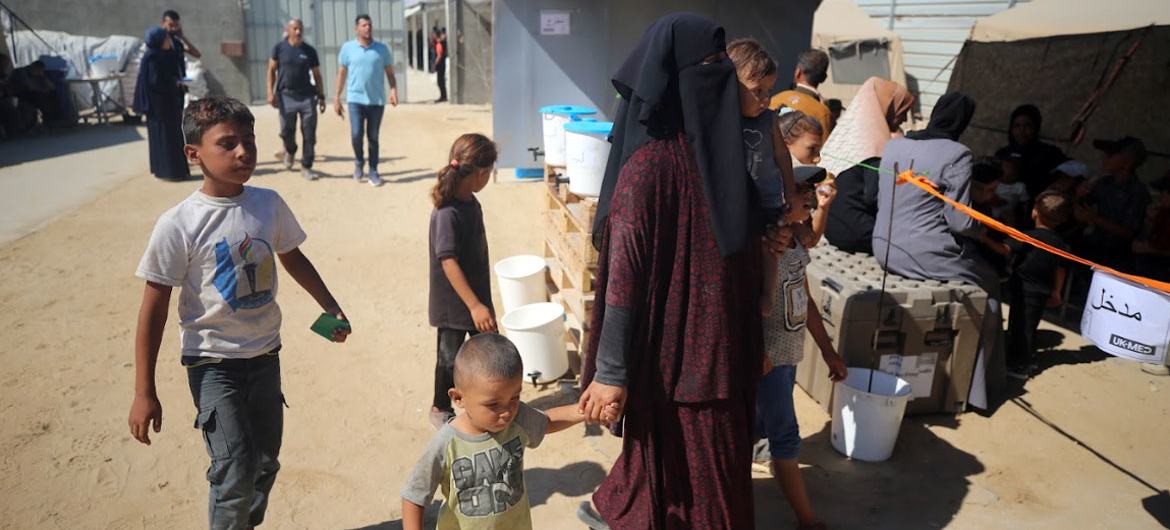
More than 500,000 women in Gaza have lost access to vital health services.
Health care under fire
The impact of the war in Gaza on women and girls is staggering: More than 500,000 women have lost access to vital services like pre- and postnatal care, family planning and treatment for infections; over 17,000 pregnant women are in severe stages of hunger.
UNFPA and its partners are dedicated to providing reproductive health support, distributing life-saving medicines, medical equipment and supplies and deploying teams of midwives and health-care workers at both official and makeshift camps.
Six mobile maternal health units have also been set up in field hospitals to deliver emergency obstetric care to mothers and their newborns wherever they are. But it is impossible to provide continuous support without a ceasefire, full access to health services and sustained funding.
Despite all the hardships she has endured, Ala’a refuses to lose heart.
“From Mohammad, my son, thanks for everything,” she wrote, expressing gratitude to the staff at the hospital.
“We are grateful for you. I hope that we meet again in better times.”
